Our Constitution

Why The Electoral College

September 22, 2024 John Barrett 0

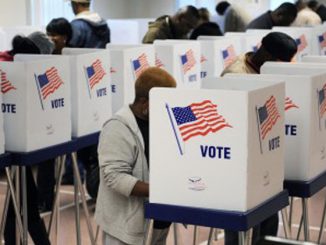
The Electoral College and the Vote…Why An Electoral College? Americans have no constitutionally protected right to vote in a federal election. We have the right to not be discriminated against in voting, based on race, color, previous condition of servitude (15th amendment), sex (19th amendment), failure to pay a poll tax (24th amendment) or age, if at least 18 (26th amendment).  But there is no right to vote in a federal election. How the electors for President are chosen is determined by each state’s legislature Following the 2000 presidential election, there was a dispute as to how votes were to be counted and recounted in Florida.  The case went to the U.S. Supreme Court, twice. […]

Our Government

Only In America, Part 3: Enter Government

June 24, 2024 thefpAdmin 0

Only in America, Part Three:  Enter Government Enter Government, Part Three:  The Founding Project introduced our readers to Dr. Jerome Huyler’s work, Only in America, breaking it into an introduction followed by a three part series.  Dr. Huyler began with the story of America and its greatness via his study of history and American life in the first chapter. His second chapter further explored America’s growth and effects of freedom, free markets and the aspects of liberty, which allowed individuals a growth, flourishing and prosperity not previously experienced by other nations. Huyler’s work is an observation of America and also on civics education in America and is being presented by The Founding Project in a series of […]

Civics

Only In America, Part 2: Keeping The Promise

June 20, 2024 Guest Writer 0

Only in American, Part Two:  Keeping the Promise Dr. Jerome Huyler’s work, Only in America: The Goodness Greatness Begot, has been featured by The Founding Project with this article being the third in the series and the second chapter of his work, entitled “Keeping the Promise”. Huyler’s work is an observation of America and also on civics education in America and is presented by The Founding Project in a series of articles.   Dr. Huyler’s essay is a response to one author’s book, which has come to influence a version of civics education in America.  But, Dr. Huyler found that book’s content did not coincide with the full civics education programs once prevalent in American schools […]

Civics

Only In America: Promise of American Life

June 14, 2024 Guest Writer 0

Only In America: The Goodness That Greatness Begot In the first chapter of Dr. Jerome Huyler’s work, Only in America, Dr. Huyler begins the story of America and its greatness via his study of history and American life. Huyler’s work is an observation of America and also on civics education in America and is being presented by The Founding Project in a series of articles.   Dr. Huyler’s essay is a response to one author’s book, which has come to influence a version of civics education in America, but he found that book’s content does not coincide with the full civics education programs once prevalent in American schools. But, if you missed his introduction to […]

Our Constitution

A Republic Versus A Democracy, Why?

June 13, 2024 John Barrett 1

A Republic Versus A Democracy… The Details: My bet is that virtually all of you have been taught that the U.S. is a democracy. That is wrong. The U.S. is a republic. And the difference is extremely important. The Constitution only refers to a form of government in one place. Article 4, Section 4, states, “The United States shall guarantee to each State in this Union a Republican Form of Government.” What is the difference between a republic and a democracy? When I was in school, I was taught that the use of representatives made us a representative democracy or republic, as opposed to a direct democracy. That is certainly in line with current dictionaries. […]

Civics

Only In America: Dr. Huyler’s Introduction

June 6, 2024 Guest Writer 2

Welcome Dr. Huyler and the “Only in America” Series! Dr. Jerome Huyler joins The Founding Project website to bring our members his publication, Only In America. Huyler’s work is a study of America and also on civics education in America and will be presented on The Founding Project website in a series of articles.  In particular, Dr. Huyler responds to one author’s book, which has come to influence a version of civics education that does not coordinate or coincide with the full civics education programs once prevalent in our schools. In Dr. Huyler’s introduction, he begins to contrast the message of this one book and its conflict with prior decades of teaching.  And, in his […]

Our Constitution

America’s First Congress

March 9, 2024 thefpAdmin 0

America’s First Congress The First Congress and Congress, as we now know it, officially began on March 4, 1789. It came into being due to America’s new Constitution, which was written in 1787.  The new Constitution of the United States of America was written in 1787.  It was ratified in 1788, when the 9th state (New Hampshire) ratified it on June 21, 1788.  It officially began operation in 1789 and is the world’s longest surviving written charter of government. Charting a Course The First Congress’ necessary tasks were many and the new form of government meant the Congress was charting a new course of freedom.  There were no examples for this Congress to follow, because […]

Our Constitution

Our First “Constitution”: The Articles of Confederation

April 17, 2023 thefpAdmin 4

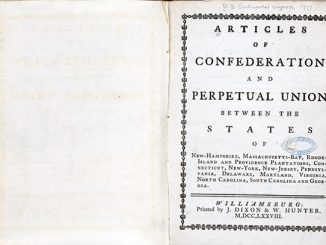
Why the Articles of Confederation failed its New Nation The Articles of Confederation was the first constitution of the United States of America. It established a confederate style of government for America, which united 13 States with their own strong governments under one purposefully weak central government. A Confederacy was born The Founders established a confederacy, because they had just fought a war (the Revolutionary War) against the British to escape an oppressively strong central government. The Founders wanted to avoid any type of strong central government. They opted to give the States the power to establish their own governments, foreign relations, trade agreements, military and economic practices. This distribution of power was chosen by […]

Politics

Campaign Manipulation and Alinsky

January 6, 2023 Margo Louis 1

How Manipulation Became Part of American Campaigns Saul Alinsky is an American author and community organizer often considered to be the father of modern community organizing.  He is often noted for his 1971 book, Rules for Radicals, along with a having a penchant for Satan.   Although, Alinsky is most often linked to recent political figures from the more liberal camps, who studied his works with great intensity, the use of Alinsky-type tactics can be found in numerous campaigns of both the social and activist type. Because the Alinsky method or methodology preys on emotions and a slow and steady manipulation of groups of people, it is important to be able to recognize these tactics […]

Our Constitution

The Powers of the Executive Branch

December 30, 2022 Clay Blanche 0

THE POWERS OF THE EXECUTIVE BRANCH The executive exercises vital powers in foreign and domestic areas. He is principally responsible for the nation’s foreign policy: He negotiates treaties, receives ambassadors,and serves as commander in chief of the military. The President may appoint officers. He is responsible for executing, or carrying out, the laws of the land, but also has the discretion to pardon. Though the Founders created a unitary executive, the legislature exercises several important checks on the executive, holding the power to declare war, advise and consent to appointments, and ratify treaties. As the only wholly national figure, the President reports to Congress on the State of the Union. The President may convene sessions […]

1 2 3