History

The Mayflower Compact

June 17, 2025 Margo Louis 0

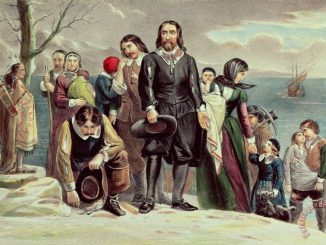
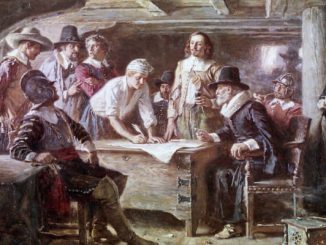
The Mayflower Compact, the first governing document of Plymouth Colony Following several brutal months at sea, the area now known as Cape Cod was finally seen on the horizon by those aboard the ship, the Mayflower, which embarked on September 16, 1620. Most, who arrived on Plymouth Rock, were sick from intense sea sickness or other illnesses.  Their original destination was intended to be Northern Virginia and the Hudson River, which is New York, today.  After months of battling storms, high winds and horrible waves, the 102 people on board didn’t care they had missed their destination by many miles. “True Pilgrims” The voyagers included “True Pilgrims” (religious separatists fleeing religious persecution by the Church […]

Our Constitution

What Are Unalienable Rights

May 4, 2025 John Barrett 0

Exploring the Source of Our Rights…and Why No Entity Can Take Them From You Thomas Jefferson was very clear as to the source of our rights and why that was important.  No matter what you may have heard about Thomas Jefferson –  I know when I was in high school, we were taught that Jefferson was an atheist – he spent a good portion of his life crediting God for our country and promoting that idea that our rights are the gift of God. In Rights of British America (1774), Jefferson wrote, “The God who gave us life gave us liberty at the same time; the hand of force may destroy, but cannot disjoin them.” […]

Economics

Government’s Debt Ceiling, Defined

April 25, 2025 thefpAdmin 0

What is the Debt Ceiling Limit? The debt ceiling is a limit imposed by Congress on how much debt the federal government can carry at any given time. When the debt ceiling is reached, the US Treasury cannot issue anymore treasury bills, bonds or notes. It can only pay bills as it receives tax revenues. In other words, each time the debt ceiling is increased, it essentially allows the federal government to pay bills above its means. Average Citizen Comparison We can compare this practice to a personal credit card issued by a bank in your name. At issue, you were given a credit limit of $3,000.00 with an interest rate of 21% per year. […]

Sources

Constitution and Founding Resources

January 3, 2025 TFP Staff 0

The Constitution and Founding Resources Consistently reliable resources for information about the Founding of the United States and the U. S. Constitution can be difficult to find.    In particular, if you seek reliable interpretation of the Constitution in keeping with the original intent, those resources can be more difficult to find. Dedicated to the Founding Principles and the U. S. Constitution The Founding Project seeks good sources for our members to use when exploring our nation’s laws and documents. With that purpose in mind, outlined in this article are some good resources for our members to use, when your needs go beyond those offered on our website. The Library of Congress The most simple […]

Our Founders

Bradford: The First Constitution of the New World

December 15, 2024 Clay Blanche 0

Bradford, Plymouth and The Mayflower Compact Preface:  William Bradford, the governor of Plymouth colony, and his famous and moving diary, a History of Plymouth Plantation, one of the great works of New England literature, will be drawn on heavily in this article. Bradford, The Pilgrims of Plymouth and the First Constitutional Government in the New World Bradford was not only a gifted writer, he would also become one of the heroic pioneers of Western history, laying the cornerstones that made possible the building of the American Republic. On August 5, 1620, the Pilgrims set sail, encountering, according to Bradford, “many fierce storms in which the ship was soundly shaken.” Amazingly, only two died on the […]

Our Founders

Richard Henry Lee and Independence

December 5, 2024 Margo Louis 1

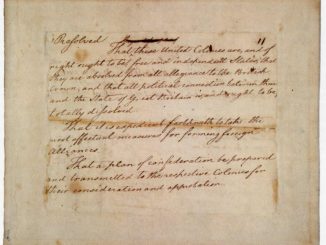
Richard Henry Lee and America’s Steps to Independence Richard Henry Lee was a prominent statesman from Virginia.  Though not a firebrand, like Patrick Henry, or quite as prolific as Thomas Paine, Lee became known as a quite the powerful orator and writer.  His words, spoken and in print, were important cogs in the wheels that churned toward America’s independence from England. Early Life Lee was born in Virginia and following home tutoring and then schooling in England, he returned to America and served as a Justice of the Peace for Westmoreland County.  In 1758, he was elected to the Virginia House of Burgesses and was later a delegate to Continental Congress. The Steps Toward Independence […]

Our Founders

Lemuel Haynes, Our African-American Founder

October 19, 2024 TFP Staff 2

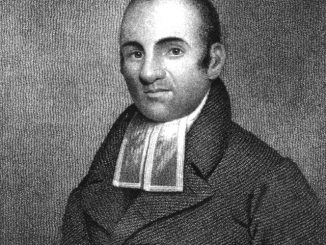
Lemuel Haynes: Pastor, Patriot, Poet On July 18, 1753, Lemuel Haynes was born to a white mother “of respectable ancestry” and an African father in West Hartford, Connecticut. His parents abandoned him as a child, giving him to a local deacon in Middle Granville, Massachusetts. Lemuel’s parents had an agreement with Deacon John Haynes that their son would work on Haynes’ farm until age 21 in exchange for housing and education. His Youth Thus, Lemuel spent his youth as an indentured servant working on a Massachusetts farm to earn his keep. He worked on the farm by day and studied at night.  With a basic education, Lemuel developed a passion for books, especially for the […]

Our Constitution

Why The Electoral College

September 22, 2024 John Barrett 0

The Electoral College and the Vote…Why An Electoral College? Americans have no constitutionally protected right to vote in a federal election. We have the right to not be discriminated against in voting, based on race, color, previous condition of servitude (15th amendment), sex (19th amendment), failure to pay a poll tax (24th amendment) or age, if at least 18 (26th amendment).  But there is no right to vote in a federal election. How the electors for President are chosen is determined by each state’s legislature Following the 2000 presidential election, there was a dispute as to how votes were to be counted and recounted in Florida.  The case went to the U.S. Supreme Court, twice. […]

The Amendments

The 14th Amendment and Rights

September 1, 2024 thefpAdmin 0

Why The 14th Amendment? After the Civil War, the United States needed to swiftly deal with several aspects of citizenship and the rights of citizens. Three amendments were ratified in July of 1868 and were collectively known as the “Reconstruction Amendments”.  The 14th Amendment was intended to protect the rights of formerly enslaved people, but has continued to play a role in constitutional politics. In response to the Emancipation Proclamation by Abraham Lincoln, the first step to free slaves, and The 13th Amendment, which freed slaves, some Southern states enacted laws known as “Black Codes”.  These “Black Codes” targeted recently freed slaves and restricted their ability to travel widely, own certain types of property and-or […]

1 2 3 4 5 7